Labs
Assignment§
A1§
cmake_minimum_required(VERSION 3.21)
project(word-count C)

# 设置编译器
set(CMAKE_C_STANDARD 99)
set(CMAKE_C_STANDARD_REQUIRED ON)
set(CMAKE_C_COMPILER clang)

add_compile_options(
"-ggdb" # gdb调试支持
"-m64"
)
# add_compile_definitions(LINE_COUNT) # 宏定义
## add_compile_definitions(MACRO_CONSTANT_NAME=macro_value)

# 生成 compile_commands.json 文件  for clangd
set(CMAKE_EXPORT_COMPILE_COMMANDS ON)

include_directories(./include) # 头文件目录

add_executable(test_strcmp.bin)
target_sources(test_strcmp.bin PRIVATE
  ./test_strcmp.c
  ./str_cmp.c
)

# target_compile_options(test_strcmp.bin PRIVATE -ggdb)
# target_include_directories(YourExecutableName PRIVATE include)


add_executable(tokenize.bin)
target_sources(tokenize.bin PRIVATE
  ./tokenize.c
  ./vector_char.c
)


add_executable(dictionary.bin)
target_sources(dictionary.bin PRIVATE
  ./dictionary.c
  ./vector_char.c
  ./vector_string.c
  ./str_cmp.c
)


add_executable(linecount.bin)
target_compile_definitions(linecount.bin PRIVATE LINE_COUNT) # 宏定义
target_sources(linecount.bin PRIVATE
  ./linecount.c
  ./vector_char.c
  ./table_string.c
  ./str_cmp.c
)


add_executable(duplicate.bin)
target_sources(duplicate.bin PRIVATE
  ./dedup.c
  ./vector_char.c
  ./table_string.c
  ./duplicate.c
  ./str_cmp.c
)


add_executable(unit_test_vector_char.bin)
target_sources(unit_test_vector_char.bin PRIVATE
  ./unit_test_vector_char.c
  ./vector_char.c
)


add_executable(unit_test_table_string.bin)
target_compile_definitions(unit_test_table_string.bin PRIVATE LINE_COUNT) # 宏定义
target_sources(unit_test_table_string.bin PRIVATE
  ./unit_test_table_string.c
  ./table_string.c
  ./vector_char.c
  ./str_cmp.c
)
tokenize
#+BEGIN_EXAMPLE
  这里放置你的代码块
#+END_EXAMPLE
首先要实现用来存放字符的动态数组:
struct vector_char {
  uint32_t len; // 当前长度(已使用)
  uint32_t max; // 最大容量
  char *data;
};
核心代码是扩容
vector_char->data =
    realloc(vector_char->data, sizeof(char) * vector_char->max);
#include "vector_char.h"
#include <stdio.h>

/* Internal functions declared here . See bottom for definition */
static void _vector_char_expand(vector_char_t *vector_char);
static void _free(void *ptr);

/**
 * @brief Allocate header for describing vector chars. Initialize internal data
 * pointer to NULL
 *
 * @return vector_char_t*
 */
vector_char_t *vector_char_allocate(void) {
  /** 为动态数组结构体本身分配空间, 将容量,长度初始化为0 */
  vector_char_t *header = (vector_char_t *)malloc(sizeof(vector_char_t));
  if (!header)
    return NULL;

  header->data = NULL;
  header->len = header->max = 0;

  return header;
}

/**
 * @brief Clean up both the header describing vector_char and internal data
 *
 * @param vector_char
 */
void vector_char_delete(vector_char_t *vector_char) {
  if (!vector_char) // 为空则直接返回
    return;

  if (vector_char->max)
    _free(vector_char->data); // 释放字符序列

  _free(vector_char); //释放结构体本身
}
/** 在添加元素时进行扩容的判断*/
void vector_char_add(vector_char_t *vector_char, char entry) {
  if (vector_char->len >= vector_char->max)
    _vector_char_expand(vector_char);

  vector_char->data[vector_char->len++] = entry;
}

/**
 * @brief Get the character at a particular location
 *
 * @param vector_char
 * @param index
 * @return char
 */
char vector_char_get(vector_char_t *vector_char, uint32_t index) {
  if (index > vector_char->len)
    exit(EXIT_FAILURE);

  return vector_char->data[index];
}

/**
 * @brief returns the internal char array as a raw pointer
 * WARNING: Do not free on the outside. This will lead to inconsistent results
 * @param vector_char
 * @return char*
 */
char *vector_char_get_array(vector_char_t *vector_char) {
  return vector_char->data;
}

/**
 * @brief Internal use only. User does not interact with these functions
 *
 */
static void _vector_char_expand(vector_char_t *vector_char) {
  if (!vector_char->max) { // 若max == 0, 则说明data没有被分配空间
    vector_char->max = 16; // 为数组首次分配空间
    vector_char->data = malloc(vector_char->max * sizeof(char));
    if (!vector_char->data)
      exit(EXIT_FAILURE);
    return;
  }
  // 将当前容量扩大两倍,重新分配空间
  vector_char->max <<= 1;
  vector_char->data =
      realloc(vector_char->data, sizeof(char) * vector_char->max);
  if (!vector_char->data)
    exit(EXIT_FAILURE);
}

static void _free(void *ptr) {
  free(ptr);
  ptr = NULL;
}
Week1§
这门课程围绕着4个伟大的想法开展:
- 抽象层级
- 局部性原理/ 内存层次
- 并行(流水线)
- 性能测量和优化
L1 数字系统§
每个数字系统都有一个基数base, 它表示最多可以使用几个符号来表示数字.
对十进制,可以使用10个符号:0-9.
每个数字可以看成是有长度为N的符号序列, 从右往左,从0开始编号到 N-1.
N位Base进制的数字的最大值是 $Base^{N-1}$
十进制 -> B进制§
$B^n, B^{n-1}, B^{n-2} , .. , B^0$
十进制num转B进制, 从小于num的最大的 $k*B^n$ 开始, k就是最高位. 然后对
$num - k * B^n$ 做相同的计算, 得到num的下一位.
L2 内存§
内存可以看作是一个大数组, 这个数组的索引被称作地址.
因此地址也是一个数字,可以被存放到内存中.
而且有些值无法用一个字节表示(>256),因此需要将多个字节看作一个"整体"来表示一个数.
机器字Word 通常指的就是这多个字节组成的整体,它的长度和其能表示的最大地址范围有关.
eg: x86系统使用了 64位 的机器字. 因此其能表示的最大地址空间是
$2^64$ . 这是一个相当大的数字, 实际不会用到这么多内存.
因此实际的地址长度是48位.
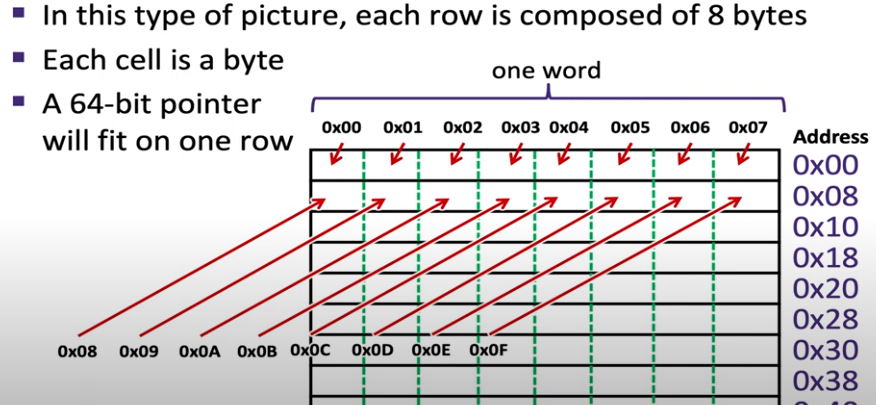
即便内存是按照机器字的大小被划分成一小块一小块, 但是其地址仍然是以字节为单位来表示的. eg: 0x00 和 0x08
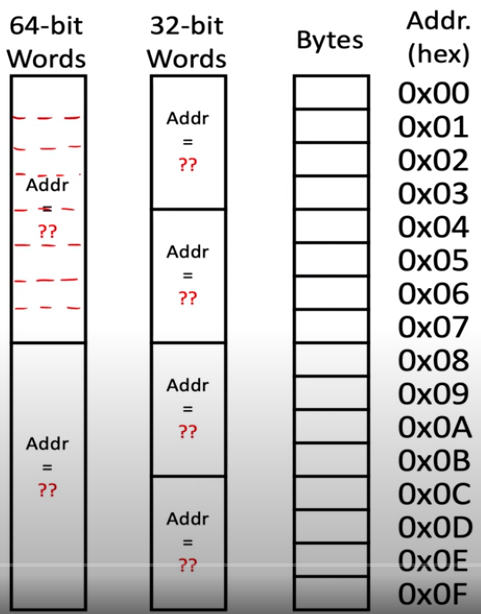
用机器字作为基本单元来表示数据时,对那些较小的数可能会导致空间的浪费, eg: 数字1只使用了机器字的第一个字节,但总体上来看还是可以接受的.
每行表示一个机器字word.每个格子表示一个字节byte.
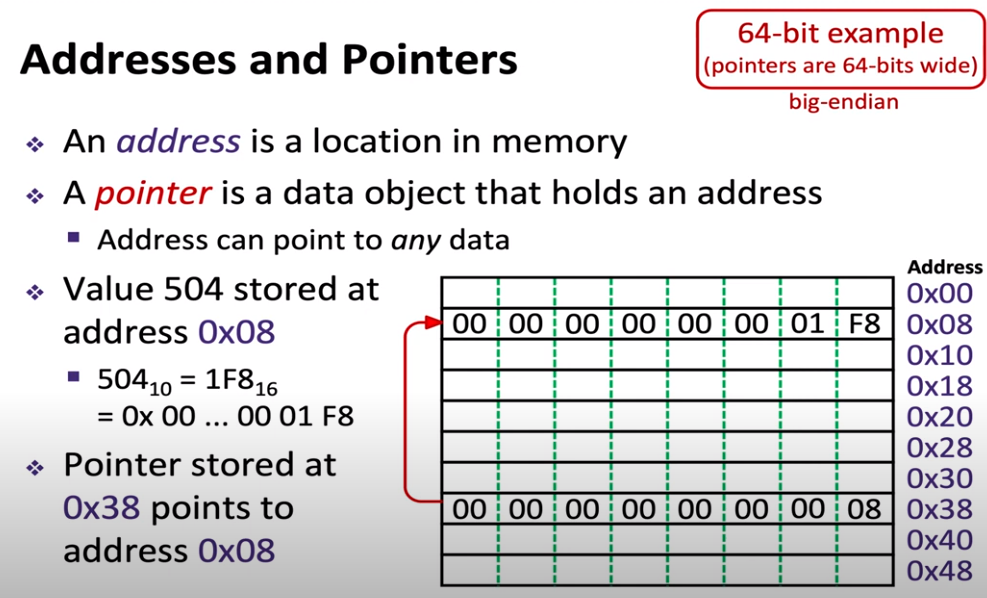
指针就是存放着地址的内存单元. 因此指针类型的长度通常和word相同
下面这个例子是采用大端表示. 左上角是第0个字节. 0x01f8
的高字节0x00先被存储, f8这个字节最后存储.
对齐§
K字节的基本对象的地址必须按照K字节对齐.
2字节对象, 地址最后一位是 0. 4字节对象, 地址最后2位是 00. 8字节对象, 地址最后3位是 000.